Christopher Columbus brought colonization and exploitation to Hispaniola
advertisement
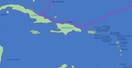
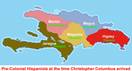
On his first voyage, Christopher Columbus explored the north coast of Hispaniola after landing in Cuba. As Columbus approaching the northern part of Hispaniola, Santa Maria sank and his team had to abandon ship. Guacanagari was one of the five caciques of Hispaniola at the time Christopher Columbus arriver in Hispaniola 1492. He was the chief of the cacic of Marien, which occupied northwest of the island. Guacanagari received Christopher Columbus and agreed to let Columbus leave some of his men there.
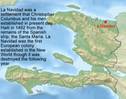
Soon after, settlement of La Navidad near present day Caracol Bay, Haiti was founded. La Navidad has been recognized as the first European colony that Christopher Columbus and his men established in the New World.
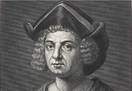
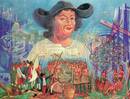
Believing the island he discovered was part of Asia, Christopher Colombus named the people Indians. This marked the beginning of European exploration that will eventually lead to colonization and exploitation of the native people. From that point on, all kinds of horrors and atrocities would be perpetrated on the native Tainos and Awarak people in that beautiful mountainous island. Columbus brought racism, colonization, slavery and exploitation to the land of Hispaniola.
Anacaona was the chief of Jaragua. Born in Yaguana, today Leogane, Haiti, in 1464, Anacaona was the wife of Caonabo. Caonabo was suspected of having organized an attack on La Navidad Spanish settlement, was captured and shipped to Spain. Caonabo doed during the transportation to Spain. Queen Anacaona received her sentence in a similar way. During a feast organized in honor of Anacaona, the Spanish governor ordered that the house where the event was taken place to be set on fire. She was subsequently arrested and hanged.
The Taíno culture that dominated the island of Hispaniola, now Haiti, for several centuries were called the indigenous people. They were they were divided into five caciquats. It was estimated that over a million Taino Indians were living in Hispaniola at the time Christopher Columbus first set foot in the Island. In less than ten years after Columbus arrived in Haiti, the majority of the Taino population had died as the Spaniards had transformed them into slaves.
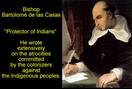
One European who became outraged by the treatment of the Native Indians in the New World, was Bartolomé de las Casas. Las Casa was originally a slave owner himself and also participated in many raids against the Tainos of Hispaniola. After he was ordained priest, in 1510, Bartolomé de las Casas became the first officially appointed "Protector of the Indians". He wrote extensively on the abuses and atrocities committed by the Europeans to the Tainos